February
Happy New Year once again! in 2026, February 17th is Seollal, the Lunar New Year, one of the biggest national holidays celebrated in South Korea. Seollal is so important that every year, South Korea gets a total of 3 days off; the day before Seollal, Seollal, and the day after. the word “Seol” means “new” and it indicates the new day of the lunar calendar.
Lunar New Year, Lost and Found
Did you know? Seollal was once lost, and only reclaimed in 1989.
In Korea, we started out using the lunar calendar. This was because back in the day, it was much easier to observe the movement and shape of the moon through a telescope rather than trying to look at the blazing sun. So a lot of holidays and patterns in farming and fishing were determined by the lunar dates.
The Gregorian Calendar we use today is a solar calendar, which Korea started using in 1896 when the King of the Empire of Korea (1896-1910) ordered a nationwide transition. What’s interesting is that with the policy change in 1896, Seollal also got moved to the Gregorian January 1st. Then came the Japanese colonization in 1910-1945, when the Japanese attempted to erase Seollal and its traditions altogether.*
*during the colonization, the Japanese oppressed Seollal celebrations by closing down Korean rice cake mills, and smearing the new hanboks of children with dirt on Seollal.
Even after the liberation from the Japanese regime, it took Korea another 40 years to reclaim Seollal as its original lunar new year. In fact, the name “Seollal” had also faded and was lost over time. After many political debates and changes around this decision, in 1989 the holiday was found once again in its original name and original date.
Apart from the major holidays, the daily lunar dates still accompany a lot of Korean old school calendars that are printed and sold today. In these calendars, you can see those lunar dates in small numbers beneath the actual date and month.
This is not only because of our holidays, but also because for the current elderly generation in Korea, it has been customary to celebrate birthdays in the lunar calendar. This is why I, too, grew up celebrating my grandparents’ birthdays several weeks after their actual birthday. With time, there will only be fewer and fewer people who actually apply their lunar birthday in Korea. But our lunar holidays will continue to be an important marker of the past, and and our love for our history and traditions.
Seollal Traditions
Here are some things Koreans do on Seollal today:
Seol-bim (설빔): Seol-bim refers to the new clothes that you wear on the new year. traditionally, children wear colorful hanboks on Seollal.
cha-rae (차례): cha-rae is a ritual performed to honor the ancestors and in this case, greet them for the new year. Typically, a table full of Korean chae-rae food arranged in a specific way and each person pays respect to the ancestors by bowing down. This tradition now varies depending on the household and religion. Growing up in a Christian household, our family forgoed the cha-rae and did a family Seollal service at home instead.
sae-beh (세배): this is the most significant and common tradition of Seollal, where the younger generation pays respect to the elderly. Usually the grandparents or the oldest in the family sits across from the rest, and each family lines up to bow to them to wish them a good year. Once the elders receive the bows, greetings and blessings, the elderly in return, share their blessings and hand each person an envelope with money. we call this sae-bet-don. When I was a kid, my sebet-don from my grandparents was where 99% of my income came from.
dduk-guk (떡국): to celebrate the new year, the extended family gets together to eat dduk guk together. I explained more about the significance of dduk guk and the recipe on the January Page
Various traditional games: Although this is not so common anymore, very traditional households will play Yutnori (a type of board game with special “dice” called Yut) as a whole family, and fly kites.
Sources:
https://news.koreadaily.com/2007/01/11/society/generalsociety/449129.html
https://m.blog.naver.com/1building/221233173706
https://ncms.nculture.org/ceremonial/story/1464#:~:text=%ED%95%9C%EA%BA%BC%EB%B2%88%EC%97%90%20%ED%95%A0%20%EB%95%8C%EB%8A%94%20%EC%84%9C%EC%AA%BD%EB%B6%80%ED%84%B0,%EB%93%B1%EC%9D%84%20%EC%A0%9C%EB%AC%BC%EB%A1%9C%20%EC%98%AC%EB%A6%B0%EB%8B%A4.
https://encykorea.aks.ac.kr/Article/E0028997
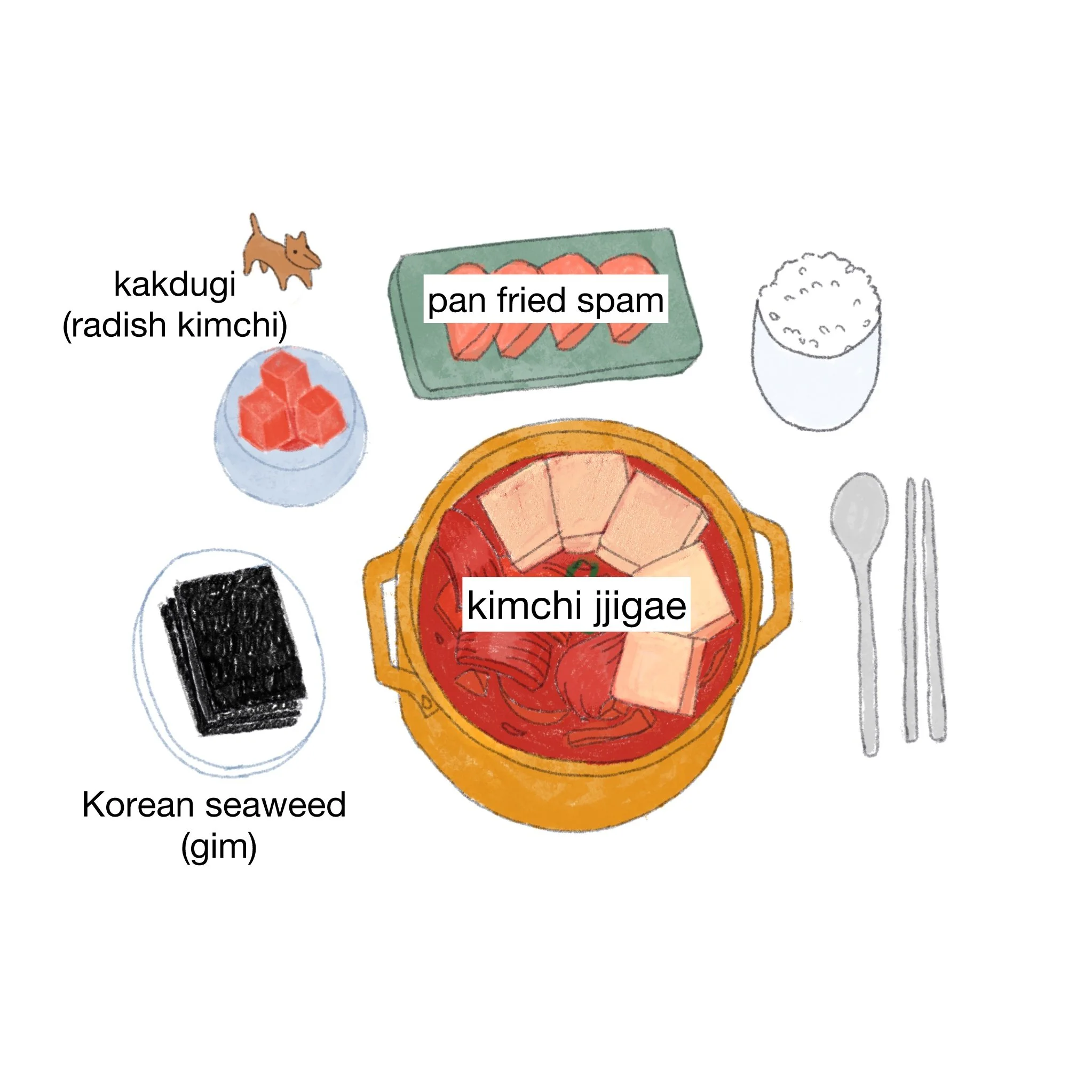
Since the tteokguk recipe is in the January page, here’s the recipe of the classic Korean soul food- kimchi jjigae.
classic kimchi jjigae Recipe

Ingredients
3 cup water (or anchovy broth)
1 Tbsp sesame oil 1/2 cup pork belly or jowl (alternative: 1 can tuna. or eliminate meat if you want)
1 cup Kimchi
1 tsp gochugaru
1 tsp minced garlic
1 tsp soysauce
1 tsp oyster sauce
1/2 medium sized onion, sliced
1/2 container of firm tofu
1 scallion, chopped
in a heated pot, add sesame oil and cook the pork for 3-4 minutes.
add 1 cup of sliced kimchi (cut into bite size) and stir fry until the kimchi is wilted.
add gochugaru, garlic, oyster sauce, and soysauce and stir fry until fragrant
add 3 cup water or broth, and boil 10 mintutes
add sliced onions, tofu, and scallions and boil another 10 minutes.
enjoy!